How to Clean Coins Without Damaging Them: The Safe Scientific Method
How to Clean Coins Without Damaging Them: There is nothing quite like the allure of a shiny coin, but as a scientist, I have to give you a harsh truth: cleaning a coin incorrectly is the fastest way to destroy its value. In the numismatic (coin collecting) world, “clean” often equals “damaged.”
However, if you have pocket change, dirty display pieces, or metal detector finds that are simply caked in mud and grime, there is a safe way to restore them. We need to remove the foreign debris (dirt and oils) without altering the surface metal or the “patina” (that desirable, aged coloration).
Here is the scientific approach to lifting grime without abrasion.
What I Use For This Job
Using the right tools saves time and protects your belongings. Here are my exact recommendations:
*As an Amazon Associate, TidyFormula earns from qualifying purchases.
⚡ The TidyFormula™ Quick Answer
The Recommendation: Use a passive soak in warm distilled water mixed with a mild, pH-neutral dish detergent, followed by an acetone rinse for stubborn grease.
- The Mix: Distilled Water + Dish Soap (Dawn/Palmolive)
- Time: 15–30 Minutes
- Effectiveness: High (for dirt/oil), Safe (for metal integrity)
The Method: “The Hydro-Surfactant Suspension”
We are going to use a technique I call The Hydro-Surfactant Suspension. Instead of scrubbing (which causes micro-scratches), we will use chemical properties to lift the dirt away from the metal surface gently.
🧪 Tools & Ingredients
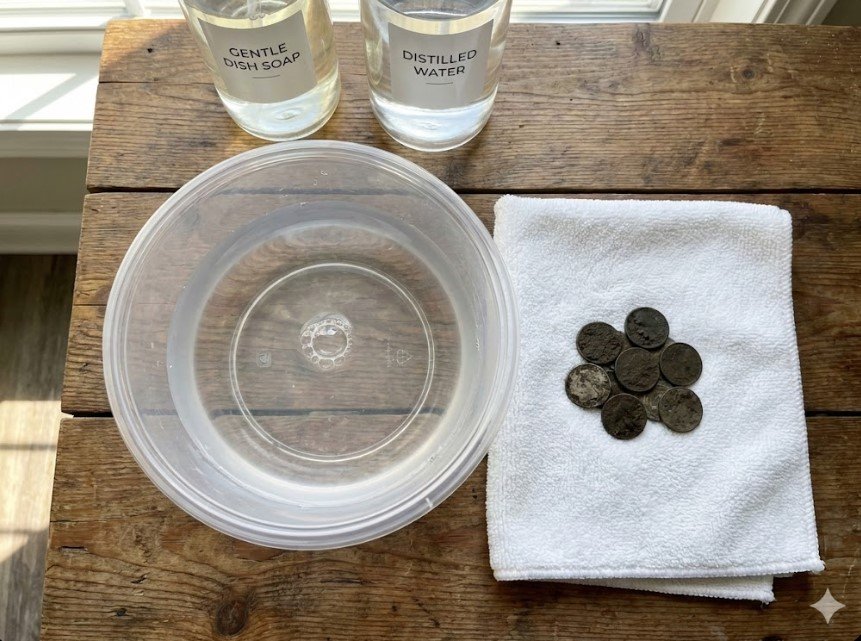
To execute this, you need to minimize mineral contamination.
Distilled Water: Crucial. Tap water contains chlorine and minerals that cause spots.
Mild Dish Soap: Acts as the surfactant.
Pure Acetone (Optional): Only necessary for sticky residue or glue (must be 100% pure, not nail polish remover).
A Soft Microfiber Towel: Or a cotton t-shirt. Never paper towels (they contain wood pulp fibers that scratch).
Plastic Container: Avoid metal bowls to prevent galvanic reactions.
Step-by-Step Instructions
Step 1: Create the Bath
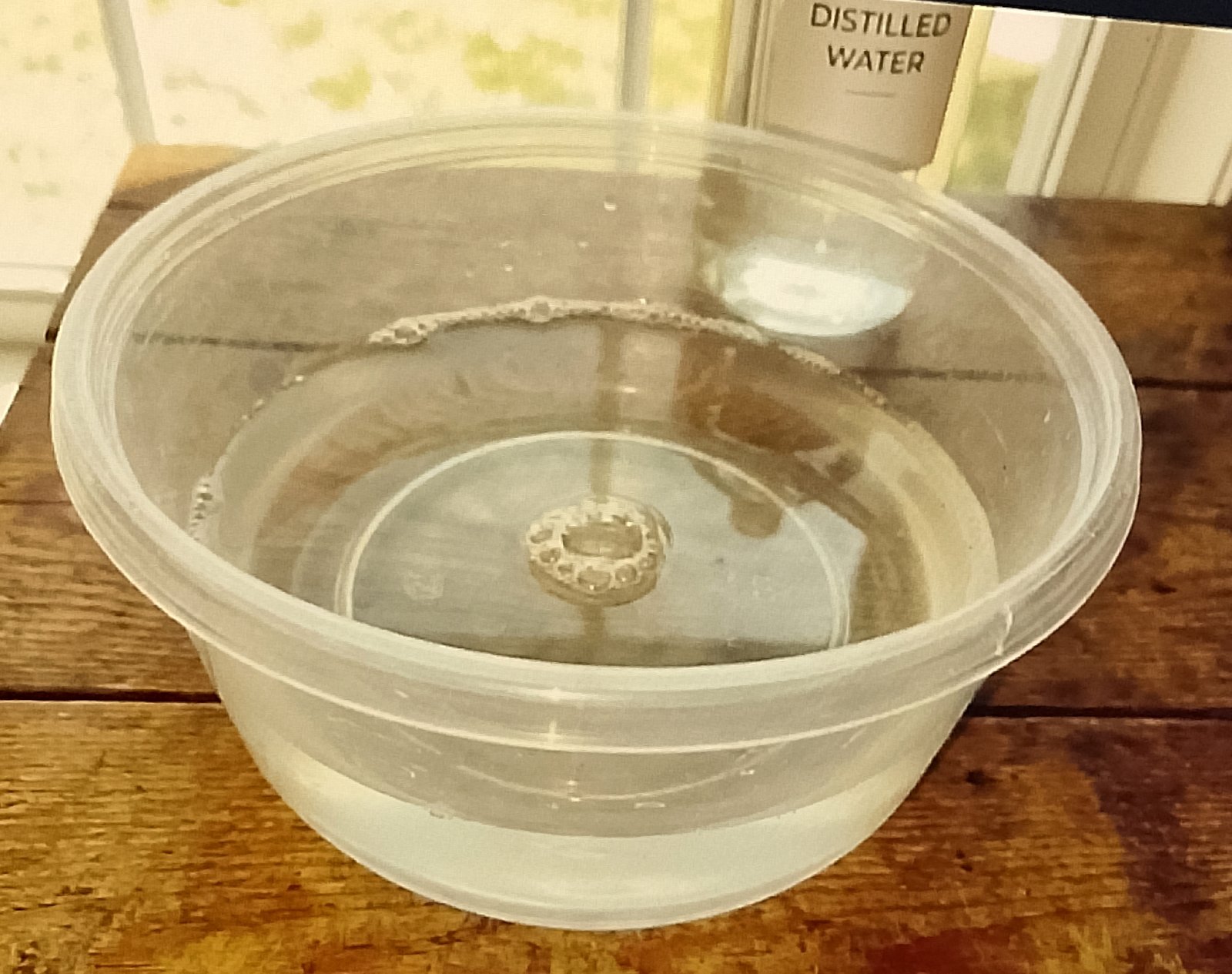
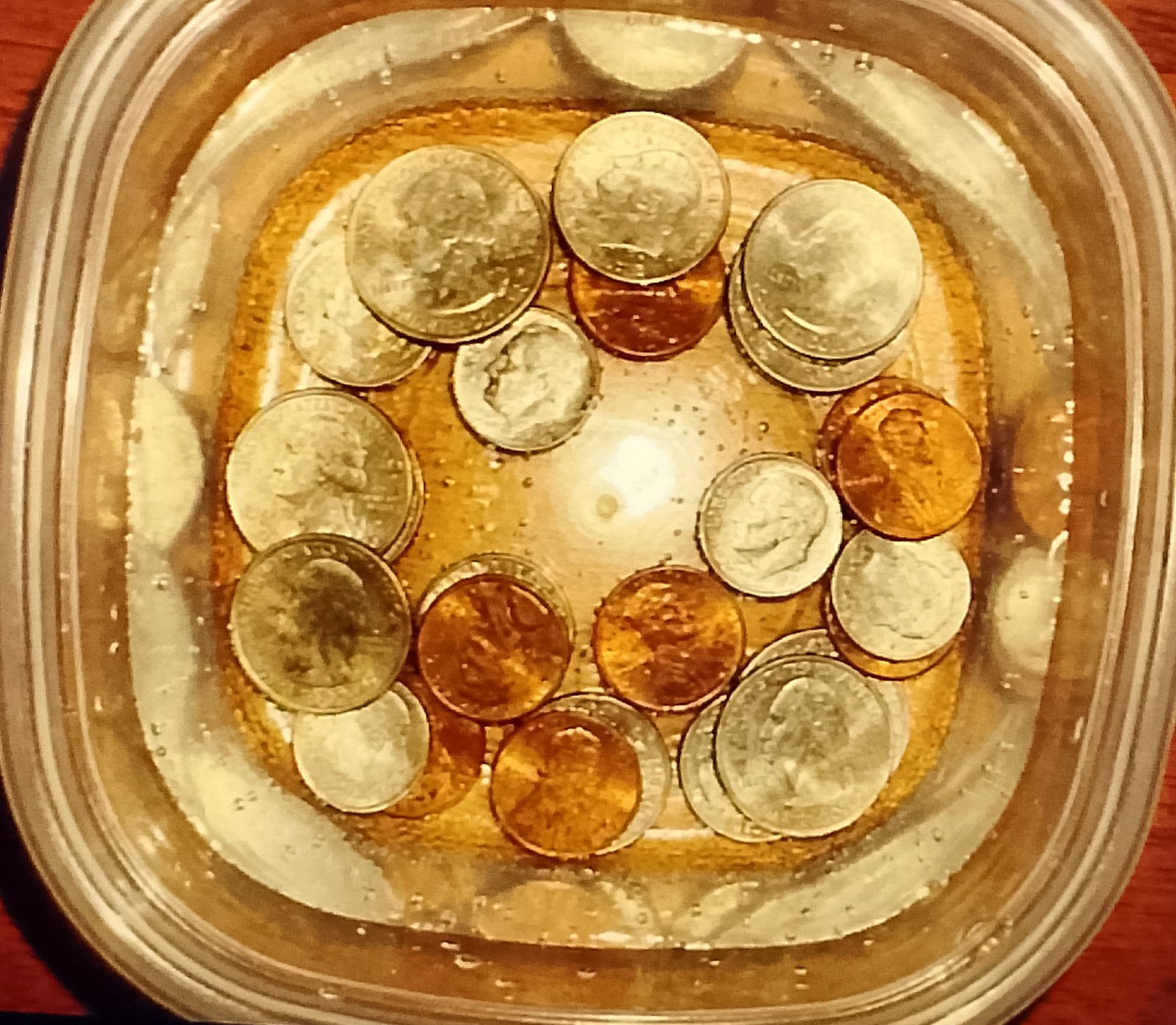
Fill your plastic container with warm (not boiling) distilled water. Add a few drops of dish soap. Mix it gently until you see suds.
Step 2: The Passive Soak
Place the coins individually into the water. Do not stack them; if they touch, water cannot reach the surfaces between them. Let them sit for 15 to 30 minutes.
Step 3: Mechanical Agitation (Fingers Only)
After the soak, pick up a coin. Gently—and I mean gently—rub the surface with the pad of your thumb. Do not use a brush. Even a toothbrush is too abrasive for a high-value proof coin.
Step 4: The Final Rinse
Rinse the coin under a stream of fresh, running distilled water. This flushes away the soap micelles that are holding onto the dirt.
Step 5: The Pat Dry
Place the coin on a soft microfiber towel. Fold the towel over the coin and pat it. Do not drag the towel across the coin. Dragging creates friction lines (hairlines).
🧪 The Science: Why It Works
This method works because of surfactants found in soap. A soap molecule has a hydrophilic (water-loving) head and a hydrophobic (water-hating) tail. When you soak the coin, the hydrophobic tails attach themselves to the oils and dirt on the coin, while the heads pull toward the water.
This creates a structure called a micelle—essentially a microscopic sphere that traps the dirt inside it. When you rinse the coin, the water carries these micelles (and the trapped dirt) away without the need for abrasive scrubbing that would scratch the metal.
Comparison: TidyFormula vs. Common Myths
There is a lot of bad advice on the internet. Here is how our method stacks up against “kitchen hacks.”
💡 Pro Tips from the Lab
Hold the Rims: The oils in your skin are acidic. Always hold a cleaned coin by the edges (the rim), never the face (obverse/reverse).
The Acetone Trick: If a coin has green “PVC slime” from being stored in bad plastic holders, water won’t move it. A 10-second dip in 100% Pure Acetone (from a hardware store) will dissolve the plastic residue without reacting with silver or copper.
Air Dry is Best: If you live in a low-humidity area, leaning the coin against a wall on a soft towel and letting it air dry is safer than touching it with a cloth.
FAQ – Frequently Asked:
🚫 Can I use toothpaste to clean my coins?
No! Toothpaste contains silica, which is an abrasive (like liquid sandpaper). While your coin will look shiny, under a microscope, the surface will be covered in thousands of scratches, destroying its numismatic value.
🧪 Does Coca-Cola clean coins?
Technically, yes, but it is damaging. Coke contains phosphoric acid. It eats away the oxides on the surface of the metal. While it removes tarnish, it leaves the metal with an unnatural, dull, “acid-washed” appearance that collectors dislike.
✨ How do I make my pennies shiny again?
If you don’t care about value and just want a science experiment, dip copper pennies in vinegar and salt. The acid dissolves the copper oxide. However, for a valuable copper coin, sticking to the soap and water method above is the only safe option.
Everything Mentioned Above
Before you leave, grab the tools you need to get the job done right the first time:
*As an Amazon Associate, TidyFormula earns from qualifying purchases.