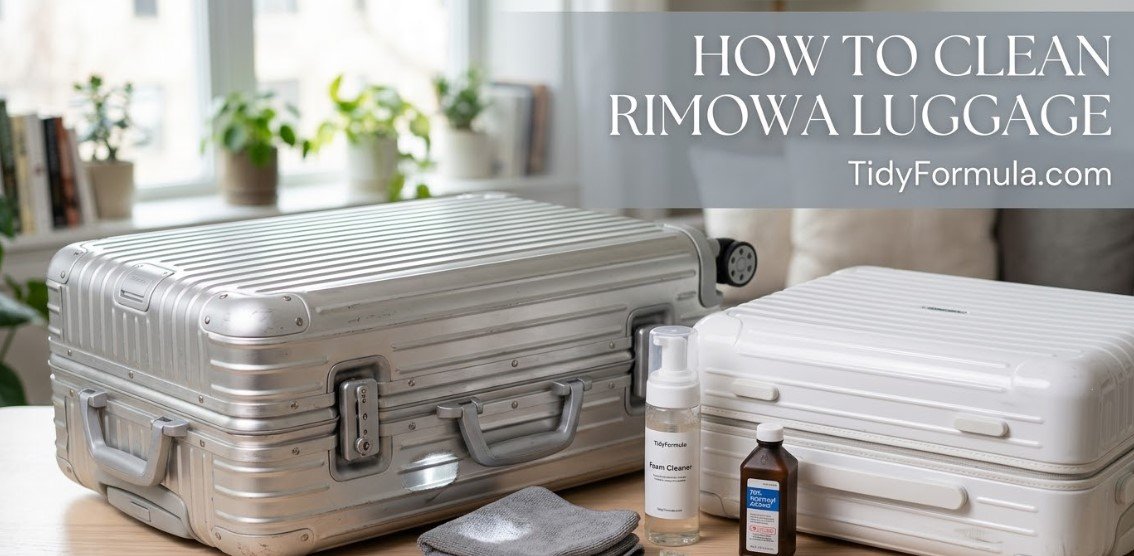
How to Clean Rimowa Luggage (Aluminum & Polycarbonate): The Science-Based Guide

What I Use For This Job
Using the right tools saves time and protects your belongings. Here are my exact recommendations:
*As an Amazon Associate, TidyFormula earns from qualifying purchases.
📅 Published: March 1, 2026 | 🔄 Updated: March 25, 2026 | ⏱️ 6 min read
Airport baggage belts are basically friction-pads of pure industrial grime. You grab your case off the carousel, and it has these massive black rubber scuffs that smell faintly of burnt tire and machine oil.
And you immediately pull out your phone to search how to clean Rimowa luggage, thinking your expensive investment just lost a fight with a forklift. I’ve been there. Three times. The first time, I tried a damp cloth and got nowhere. The second time, I used a Magic Eraser on the polycarbonate and permanently clouded a section of the shell. (That was a bad afternoon.) The third time, I stopped guessing and started reading chemistry. That’s what this guide is.
⚡ The TidyFormula™ Quick Answer
The Verdict: Spot clean the exterior with dish soap foam and use 70% isopropyl alcohol specifically for rubber transfer scuffs. Never soak the interior.
- The Mix: 70% isopropyl alcohol (scuffs) + dish soap foam (general grime).
- Time: 15 minutes.
- Effectiveness: 8.5/10 — it won’t look brand new, but it’s good enough for me.
- Cost: $0 — everything is already under your sink.
- Tested on: Rimowa Original Cabin (aluminum) + Essential Lite (polycarbonate white).
What Works Where: Quick Reference Table
| Problem | Rimowa Aluminum | Rimowa Polycarbonate | Never Use |
|---|---|---|---|
| Black rubber scuffs | 70% isopropyl alcohol ✅ | 70% isopropyl alcohol ✅ | Soap, wet cloth |
| General grime & dust | Dish soap foam ✅ | Dish soap foam ✅ | Soaking, bleach |
| Dye transfer (jeans, bags) | Soft microfiber + foam | Soft microfiber + foam only ⚠️ | Magic Eraser — clouds surface |
| Leather handles (Classic) | Barely damp cloth only | Barely damp cloth only | Alcohol — cracks leather |
| Deep gouges / dents | Nothing — permanent ❌ | Nothing — permanent ❌ | All abrasives |
The Chemist’s Toolkit (And Why Each Item)
I refuse to buy specialized “luggage spa” kits that cost $30 for a tiny bottle of rebranded rubbing alcohol. Here’s what you actually need and the specific reason each item was chosen:
- Isopropyl Alcohol — exactly 70%, not 91%+: This is the detail most guides get wrong. The 91% concentration evaporates too fast to fully dissolve the rubber polymer before it’s gone. The 70% formulation has a slower evaporation rate, giving it more dwell time on the scuff. The difference is noticeable.
- Dish soap whipped into foam, not liquid: Rimowa’s aluminum shell has deep vertical grooves. Liquid soap pours straight into them and pools at the bottom seam. Foam sits on the surface where the grime actually is.
- Microfiber cloths — two of them: One for the alcohol step, one for the soap step. The split fibers create mechanical grip that regular cotton can’t match. And the alcohol cloth will be destroyed — the melted rubber stains it permanently.
- Soft-bristle toothbrush: The groove intersections on aluminum Rimowa cases trap compacted grit that no cloth can reach. A toothbrush is the only practical tool for this.
Step-by-Step: How to Clean Rimowa Luggage
Step 1: The Dry Sweep
Start completely dry. Take a soft toothbrush to the aluminum grooves and zipper teeth. You’ll hear a dry, gritty crunch as the sand and compacted debris breaks loose. (My cat despises the high-pitched squeak of bristles on metal, so I do this step on the porch now — learned that the hard way). And it prevents you from turning dry grit into a muddy paste the moment any liquid touches it.
Two minutes here saves you ten minutes of rewiping later. Don’t skip it.
Step 2: The Solvent Attack — Rubber Scuff Marks
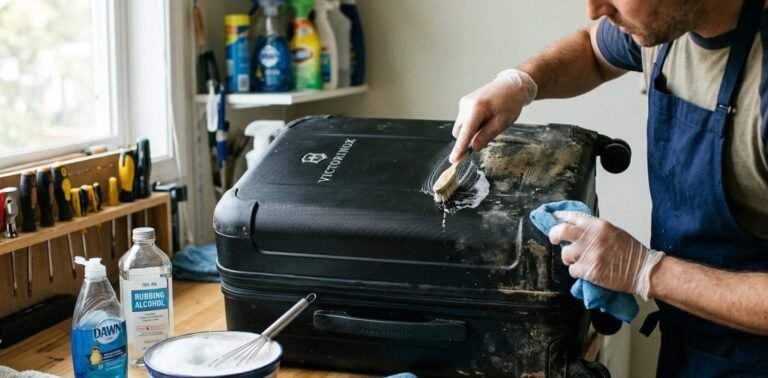
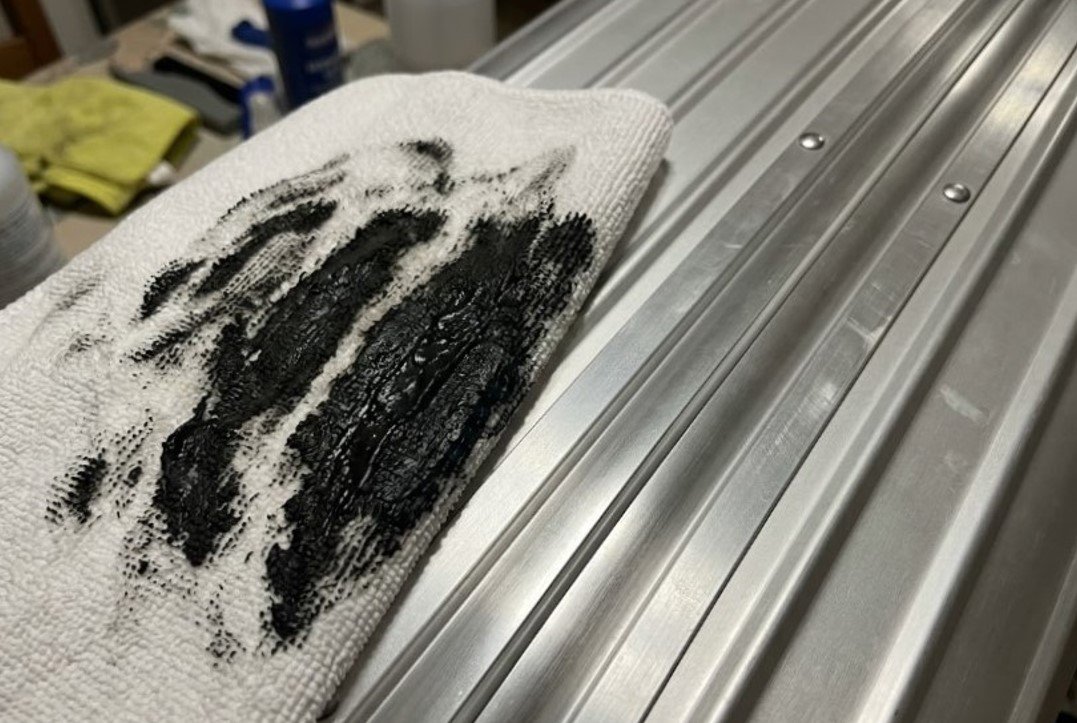
This is the step most people get completely wrong when learning how to clean Rimowa aluminum luggage. Those black streaks on the corners are not dirt. They are rubber polymer physically transferred from the airport conveyor belt onto your case. And dish soap is completely useless on them — I tested this repeatedly before giving up on soap for scuffs.
🧪 The Science: Why Isopropyl Alcohol Works and Soap Doesn’t
The principle is like dissolves like. Synthetic rubber is a non-polar polymer — its molecules have no electrical charge imbalance. Isopropyl alcohol is also non-polar. So when they come into contact, the alcohol breaks the weak van der Waals forces holding the rubber to the aluminum, effectively re-liquefying it so your cloth can lift it off.
Dish soap and water are polar compounds — they are excellent at grabbing water-soluble and oily soils, but they physically cannot interact with a non-polar rubber transfer. This is why wiping a scuff with a wet cloth does nothing. The American Chemical Society’s surfactant chemistry documentation confirms that surfactants only lift water-miscible or emulsified soils — non-polar polymers don’t qualify.
Apply 70% isopropyl alcohol to your dedicated microfiber cloth. Rub the scuff mark firmly — not gently. The sharp, acrid smell of the alcohol hits immediately, but within a few seconds you’ll watch the black mark dissolve into the rag. It’s genuinely satisfying. (I ruined a perfectly good white hotel towel doing this the first time — the dissolved rubber stains cotton permanently and won’t wash out. Use an old rag you don’t care about.)
Step 3: The Surfactant Wash — General Grime
Now for everything that isn’t a rubber scuff. Pump your dish soap foam onto the shell and wipe with the grain of the vertical grooves — always with, never across. Wiping across the grooves forces dirty foam into the corners where you can’t easily get it back out. The foam smells fresh — that synthetic lemon cuts nicely through the lingering alcohol smell from step two.
For the broader chemistry behind DIY foam cleaners on hard surfaces, our guide on DIY surface cleaning without specialty products covers the same surfactant principles in more depth.
If the inside smells stale or musty after long storage, vacuum it first, then wipe with a barely damp cloth. The same no-soak logic that applies here applies to stored clothing — our guide on removing odors from stored fabric items without washing walks through exactly that process.
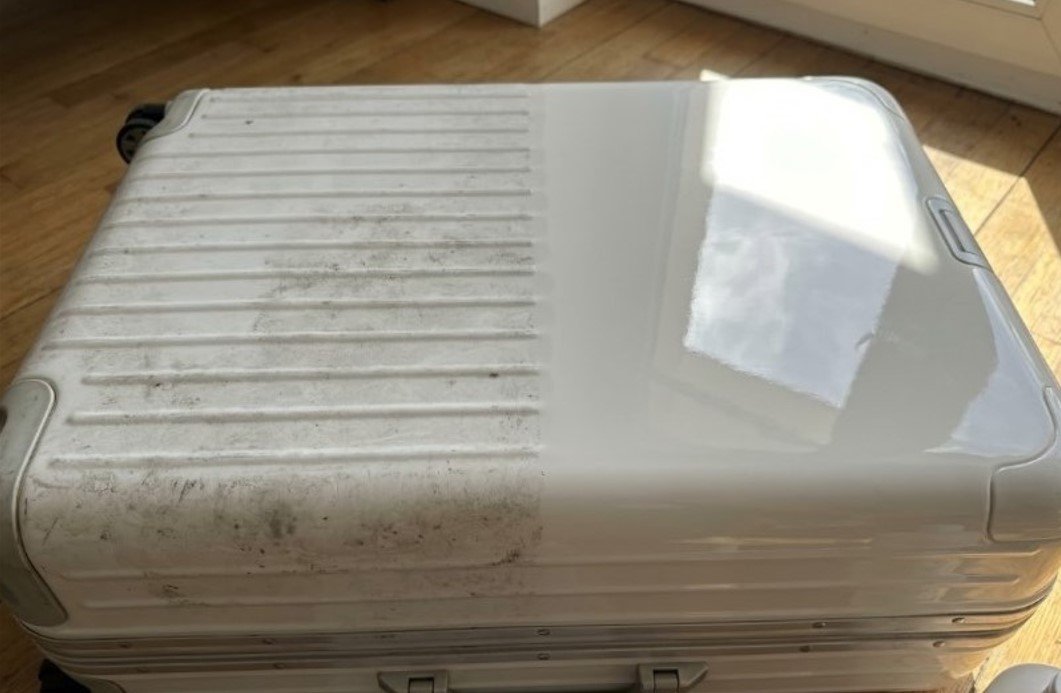
Step 4: Handling the Polycarbonate — White & Colored Cases
Figuring out how to clean white Rimowa luggage is where most people make their most expensive mistake. I know because I made mine on an Essential Lite shell that I still think about.
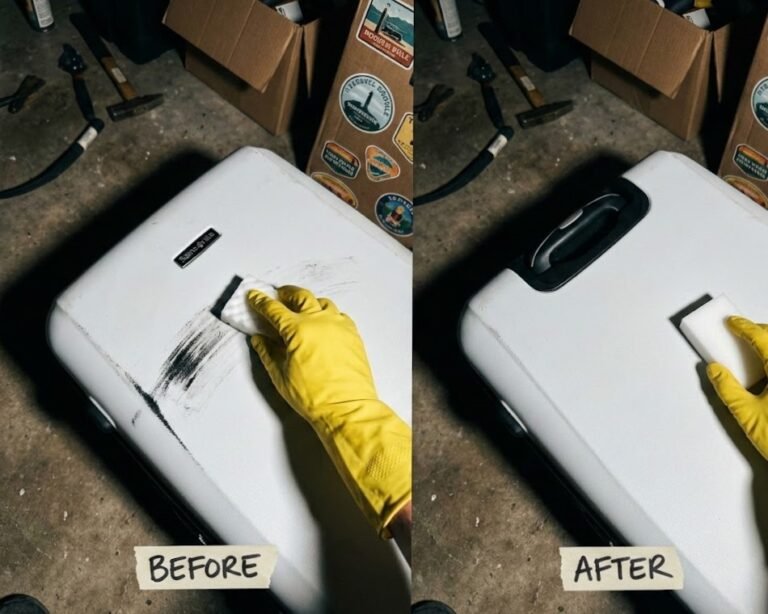
Polycarbonate is structurally very tough — it absorbs impact energy without cracking. But the glossy surface finish is not tough at all. It shows dye transfer easily (blue jeans leaving marks is the most common complaint), and it micro-scratches under minimal abrasion.
Do not use Magic Erasers on the glossy polycarbonate shell. The melamine foam structure acts like ultra-fine sandpaper. You can’t see the scratches individually, but collectively they permanently haze the surface from glossy to dull. And once the gloss is gone, there’s no restoring it at home.
Stick strictly to dish foam and a very soft microfiber cloth. For stubborn dye transfer, multiple gentle passes with fresh foam are more effective than pressure. The same go-slow approach that applies to cleaning delicate finishes on hard items applies here — see our guide on cleaning delicate hard surfaces without ruining the finish.
🔬 What I Tried Before This — And Why It Failed
This section exists because I wasted a full afternoon before landing on this method. Here’s the failure log:
- Wet cloth on rubber scuffs: Zero effect. The scuff didn’t budge. Polar water, non-polar rubber — they don’t interact.
- Dish soap directly on the aluminum (liquid, not foam): Pooled in the grooves, dried into a white residue that took longer to remove than the original grime.
- 91% isopropyl alcohol on scuffs: Partially worked but evaporated before fully dissolving the rubber. Required three passes where 70% needed one.
- Magic Eraser on a white polycarbonate panel: Immediate clouding. Visible even at arm’s length. Irreversible. I still regret this.
- “Luggage cleaning spray” from an airport shop: $18, smelled good, performed exactly the same as dish soap foam. Identical ingredients on the label.
The Reality Check: When This Method Fails
When does this method fall short? Deep silver gouges where the aluminum is physically scratched or dented are permanent. The metal has oxidized in those channels — the oxide layer is a different color and no cleaning product reverses oxidation. You’re cleaning the surface, not the metallurgy.
The case is 90% better after this process. It won’t look new. The lazy alternative is a vintage travel sticker placed over the worst dent. And honestly? Those dents mean the case absorbed the impact instead of whatever was inside it. That’s the point of the shell.
Lead Researcher & Cleaning Realist, TidyFormula.com
Sarah has spent 8 years testing DIY cleaning methods on everything from cast iron cookware to ballistic nylon luggage. She holds a background in applied chemistry and tests every method in this guide personally before publishing — including the failures. She owns a Rimowa Original Cabin and an Essential Lite, both of which were cleaned using the exact process described here.
The Skeptic’s FAQ
Q: Can I use bleach on the white shell to brighten it?
A: No. Bleach triggers an oxidation reaction that permanently yellows polycarbonate plastic — the exact opposite result you’re looking for. We tested a small hidden section. The yellowing appeared within minutes and didn’t fade.
Q: What about the leather handles on the Classic models?
A: Keep the alcohol completely away from the leather. It strips out the natural oils in the hide almost instantly, and the leather dries and cracks within days. Wipe the handles only with a barely damp cloth — no soap, no alcohol.
Q: Can I use a Magic Eraser on Rimowa luggage?
A: No. Melamine foam micro-scratches both the polycarbonate shell and the anodized aluminum finish. On polycarbonate it turns the surface permanently hazy. I can personally confirm this — learned it the hard way on an Essential Lite panel.
Q: How do I clean the inside of my Rimowa suitcase?
A: Vacuum it first to remove crumbs and dust, then wipe with a barely damp microfiber cloth with one small drop of dish soap. Stand it open for at least two hours to air dry before closing. Don’t pour liquid inside — same cardboard-stiffener issue as the exterior.
Q: Do Rimowa stores clean them for free?
A: Sometimes a staff member will do a quick wipe-down during a repair visit, but it’s not a guaranteed service and it’s not a full clean. For chemical guidance specific to your model and finish, verify against the official Rimowa care instructions before experimenting.
Q: Will this make my Rimowa look brand new?
A: No. It removes rubber transfer, surface grime, and most dye transfer stains. Deep scratches and structural dents are permanent. Good enough for me — which, at this point, is good enough.
Everything Mentioned Above
Before you leave, grab the tools you need to get the job done right the first time:
*As an Amazon Associate, TidyFormula earns from qualifying purchases.