
How to Clean a Pool Bottom Without a Vacuum (The Garden Hose Hack)
To clean a pool bottom without a vacuum, prime a garden hose with water, place the discharge end below the pool’s water level, and use the submerged end as a small siphon. Move it slowly over settled sand, dirt, or dead algae while keeping it underwater.
This method is inexpensive and effective for spot-cleaning fine debris. It is not the best choice for large leaves, thick live algae, or pools without a safe location for discharging water.
⚡ The TidyFormula™ Quick Answer
The Verdict: Use a garden hose to create a manual siphon and pull settled debris off the pool floor without a vacuum.
- The Tool: A standard 5/8-inch garden hose.
- Time: About 10–15 minutes to set up.
- Best For: Sand, dirt, and dead algae that have settled on the bottom.
- Not Ideal For: Big leaves, twigs, thick live algae growth, or cleaning the entire floor of a large pool.
- Important Requirement: The discharge end must be lower than the pool’s water surface, and the discharged water must have somewhere safe to go.
Before you start: identify what is on the pool floor
The garden hose method works best when the debris is loose, fine, and already settled. Identifying the material first will keep you from stirring up the pool or clogging the hose.
- Sand or grit: Feels coarse, stays in place, and usually collects in low spots or seams.
- Ordinary dirt: Looks brown or gray and may form a cloud when disturbed.
- Dead algae: Often looks like fine gray, tan, or pale green dust that returns to the floor after the water settles.
- Live algae: May cling to the floor or walls, feel slippery, or create green water. It requires brushing and correcting the underlying water-balance or sanitation problem.
- Leaves and twigs: Should be removed with a leaf rake or net rather than pulled into a narrow garden hose.
If the water is cloudy because the floor was recently brushed, allow the suspended material to settle before siphoning. Turn off circulation only long enough for the debris to settle and complete the cleaning; do not leave the pool without appropriate circulation during an algae treatment.
What I Use For This Job
Using the right tools saves time and protects your belongings. Here are my exact recommendations:
*As an Amazon Associate, TidyFormula earns from qualifying purchases.
The easiest way to clean a pool bottom without a vacuum
The goal is simple: fill the hose with water, place the drain end lower than the pool, and let gravity pull water out. That creates steady suction at the submerged end, which lifts debris off the floor.
The outlet only has to be lower than the pool’s water surface, not necessarily lower than the pool floor. A greater vertical drop usually produces stronger flow. This makes the method especially convenient for many above-ground pools, but it may not work well where an in-ground pool is surrounded by level or elevated ground.
What you need
- A garden hose, preferably without a spray nozzle
- A pool-safe weight or a way to secure the intake loosely to a telescoping pole or broomstick
- A spot lower than the pool water level for the drain end
- A safe discharge area that will not flood a building, wash out soil, or send pool water where local rules prohibit it
- Optional: a soft pool brush and leaf net for preparation
Step 1: Remove debris that could clog the hose
Use a leaf net to remove leaves, acorns, insects, twigs, and other pieces wider than the hose opening. If necessary, use a pool-compatible brush to move scattered fine debris into a small pile.
Avoid aggressive brushing immediately before siphoning. The debris needs to remain on the floor where the hose can collect it.
Step 2: Secure the intake end
Loosely attach the intake end to a telescoping pole or smooth broomstick so you can guide it from outside the pool. Leave the hose opening exposed and position it slightly beyond the end of the pole.
For a vinyl-lined pool, do not place a bare brick, sharp clip, metal coupling, or rough weight directly on the liner. Inspect the hose end for sharp edges before lowering it into any pool.
Step 3: Fill the hose completely with water
Put one end of the hose under the pool water and connect the other end to the spigot. Let water run until the hose is completely full and the air bubbles stop. This part matters. If air stays in the line, the siphon will fail.
You can also prime the hose without a spigot by slowly feeding the entire hose underwater until no bubbles remain. While both ends are submerged, cover the end that will become the discharge end before carrying it out of the pool.
Step 4: Shut off the water and move fast
Turn off the spigot. Cover the hose end with your thumb as soon as you disconnect it. Then carry that end to a point lower than the water level of the pool.
Keep the intake end submerged during this step. Avoid kinks, tight coils, or high loops that can trap air and weaken the flow.
Step 5: Release the drain end
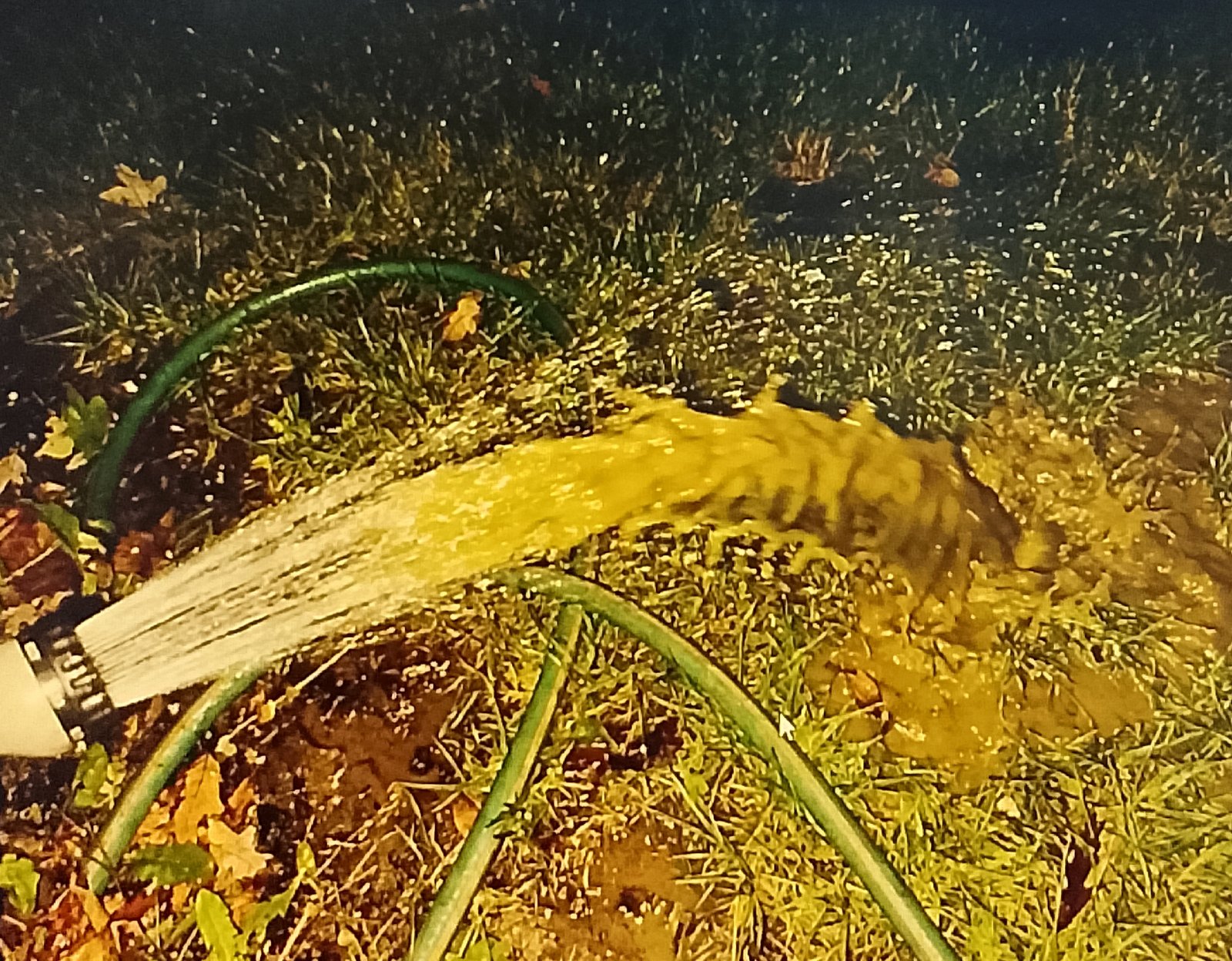
Once the hose end is below pool level, release your thumb. Water should begin flowing out. If nothing happens, there is probably still air in the line, the hose is kinked, or the outlet is not low enough. Correct the problem and prime the hose again.
Step 6: Move the intake end slowly across the dirt
Take the underwater end and move it slowly over the debris on the pool floor. Hold the opening just above the surface rather than scraping it along the floor. Go slower than you think you need to. If you move too fast, you will stir up the dirt and make the water cloudy instead of removing it.
Clean a small section at a time. Periodically check the discharge flow and the pool’s water level. Stop if the flow suddenly weakens, the hose clogs, or the intake begins pulling against a vinyl liner.
🧪 Why this works
When the hose is full of water and the drain end is lower than the pool’s water surface, gravity keeps water moving through the hose. That continuous flow carries loose debris into the intake and out through the discharge end. Air breaks the continuous water column, which is why the hose must remain full and submerged at the intake.
When this hose method works best
- Works well for: fine dirt, sand, dead algae dust, and small settled debris
- Works poorly for: large leaves, acorns, twigs, and anything that clogs the hose
- Helps but does not solve: live algae problems, especially if the pool chemistry is off
- Best used for: spot cleaning rather than routinely cleaning every inch of a large pool
- May not be practical when: there is no safe discharge point below the pool’s water surface
How to avoid damaging the pool surface
The siphon works on common pool surfaces, but the hose and anything used to guide it must be appropriate for the material.
- Vinyl liners: Use a smooth hose end and a soft nylon pool brush. Do not drag metal couplings, bricks, rough weights, or sharp fasteners across the liner.
- Fiberglass pools: Keep the hose opening slightly above the floor and use a nonabrasive pool brush.
- Plaster or concrete pools: Use a brush approved for the surface, and avoid repeatedly scraping the hose fitting over the finish.
- Painted surfaces: Do not use a stiff household broom or abrasive attachment that could loosen the coating.
If the hose grabs the surface, stop the flow by raising the discharge end to pool level. Reposition the intake rather than pulling it forcefully.
How to remove larger debris without a vacuum
If your problem is leaves instead of dirt, the siphon is not the best tool. The hose can clog quickly. In that case, use a leaf net or gather the debris into one area first.
For round pools, a simple current method can help: walk around the edge in one direction to push floating debris and loose bottom debris toward the center, then scoop it with a net. Move carefully, avoid running on wet surfaces, and wait for disturbed material to settle before collecting it. This is not perfect, but it works better for leaves than trying to force them through a garden hose.
A deep-bag leaf rake is generally more effective than a flat skimmer net for debris resting on the bottom. Approach the pile slowly so the water movement does not scatter it.
What if the dirt is actually algae?
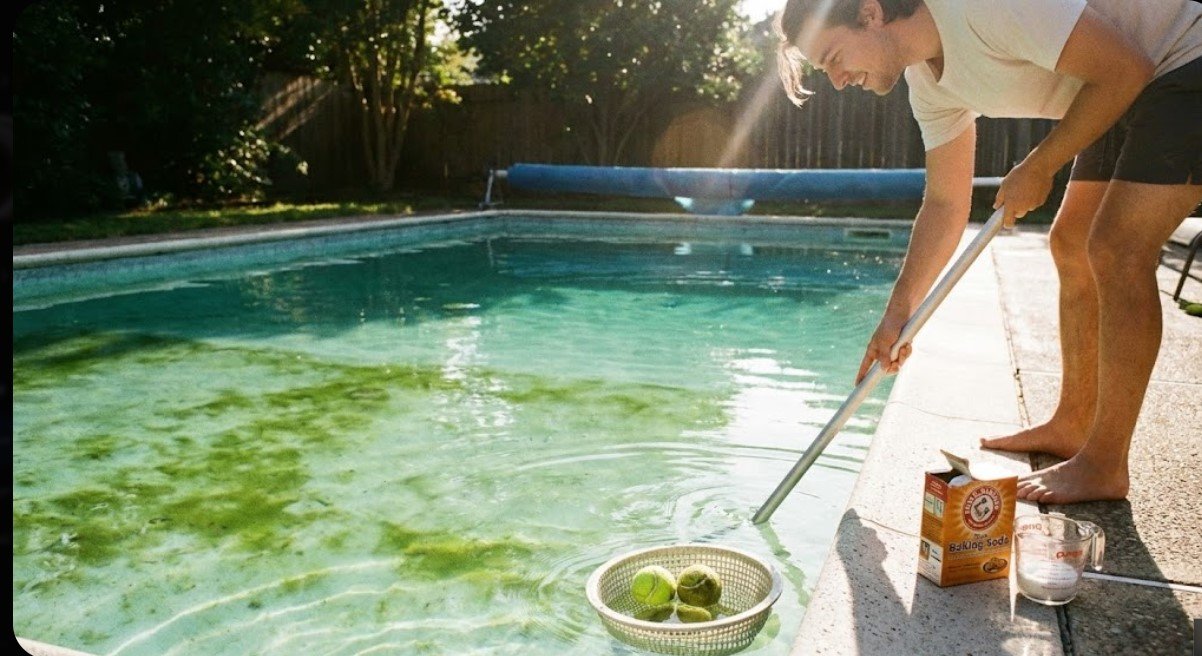
If the “dirt” is green, dusty, slippery, or keeps coming back after you remove it, that is usually an algae issue, not just a debris issue. Removing what is on the floor helps, but the real fix is keeping the water balanced and brushing the pool regularly so algae cannot keep settling and growing.
- Brush daily during an algae problem: It loosens growth from the walls and floor.
- Watch your water chemistry: Test the water and follow the directions for your pool-care products. If balance or sanitizer levels are off, algae may keep returning.
- Clean or backwash the filter when needed: Follow the filter manufacturer’s instructions, especially after collecting a large amount of dead algae.
- Use the siphon mainly for settled dead algae: It is much better for cleanup than for solving the root cause.
Do not keep siphoning if green material remains attached to the surface or immediately grows back. Brush the affected areas and address the water condition before repeating the cleanup.
Troubleshooting a garden hose siphon
No water comes out
The hose probably contains trapped air, has a closed nozzle, or does not have enough elevation drop. Remove any spray nozzle, straighten the hose, lower the discharge end, and prime the entire hose again.
The suction is weak
Check for kinks, air leaks at hose connections, and debris in the intake. A shorter, wider hose generally allows better flow than a very long or narrow hose. Increasing the distance between the pool’s water surface and the discharge end may also improve flow.
The siphon stops while cleaning
The intake may have surfaced, the outlet may have been raised too high, or an air pocket may have entered the line. Keep the discharge end in place, fully submerge the intake, and reprime if flow does not resume.
The pool becomes cloudy
Stop moving the hose and allow the material to settle again. When you restart, hold the intake just above the debris and move more slowly. Trying to chase suspended dust with the hose is inefficient.
The hose becomes clogged
Stop the siphon by lifting the discharge end to pool level. Remove the hose from the pool and flush the obstruction out in a safe area. Do not force a stick or sharp object through the hose while it is resting against the pool liner.
What to do after cleaning
Once the visible debris is gone, raise the discharge end to the pool’s water level to stop the siphon before removing the intake.
- Check the pool’s water level and add fresh water if necessary.
- Restart circulation after confirming the water is high enough for the skimmer and pump.
- Test the water after a significant refill and make any needed adjustments according to your pool-product directions.
- Rinse dirt from the hose and allow it to drain before coiling it for storage.
- Store the hose out of direct sunlight when practical, without tight kinks that could restrict future flow.
To reduce future buildup, skim regularly, brush low-circulation areas, keep the filter maintained, use a pool cover when appropriate, and rinse dirt from feet or pool toys before they enter the water.
Pool cleaning methods compared
| Method | Cost | Effort | Best For |
|---|---|---|---|
| Garden Hose Siphon | $0 if you already own the hose | Medium | Spot cleaning settled dirt, sand, and dead algae |
| Leaf Net | Low | Low to Medium | Leaves, bugs, and bigger debris |
| Pool Brush and Filter | Low if you own a brush | Medium | Loosening attached material so the filtration system can collect it |
| Manual Pool Vacuum | Moderate | High | Full floor cleaning |
| Robotic Pool Cleaner | High | Very Low | Routine hands-free maintenance |
FAQ
Can I use a Shop-Vac to clean my pool?
A wet/dry vacuum may collect a very small amount of water and debris, but it fills quickly and introduces an electrical appliance near the pool. It is not a practical substitute for routine pool vacuuming. Do not use an ordinary dry vacuum, and never place an electrical vacuum where it could fall into the water. A garden hose siphon avoids that electrical risk and provides continuous drainage.
Will this work on an above-ground pool?
Yes. In many cases it works very well on above-ground pools because it is easier to get the drain end clearly lower than the pool’s water surface. It can also work on an in-ground pool, but only if the surrounding property provides a lower, permitted discharge location.
My hose keeps floating up. What should I do?
Attach the intake end loosely to a telescoping pole or smooth broomstick. Leave the opening uncovered and use the pole to hold it just above the floor. Avoid placing a brick or rough metal weight directly on a vinyl liner.
Why is the suction weak?
The usual causes are air in the hose, a kink, a partially blocked intake, a drain end that is not low enough, or a hose that is too narrow or too long for the job. Remove attachments, straighten the line, lower the outlet, and reprime it.
Can I drain the dirty water onto my lawn?
Small amounts may be acceptable in some locations, but avoid discharging recently treated water onto delicate plants, near foundations, onto neighboring property, into septic systems, or into storm drains. Prevent erosion and standing water, and follow local water-disposal rules.
Everything Mentioned Above
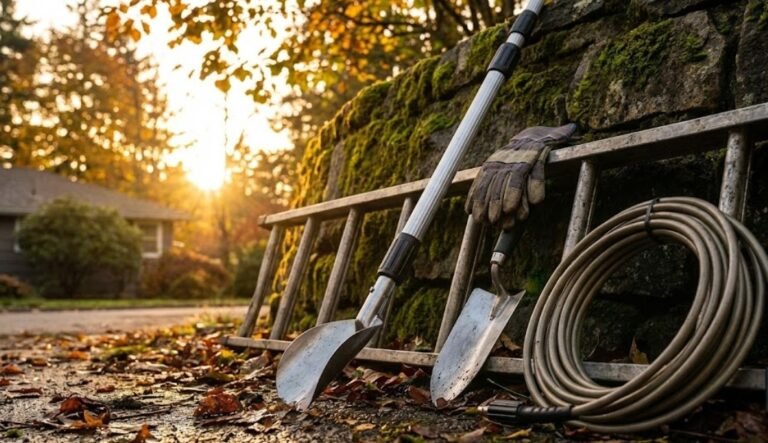
Before you leave, grab the tools you need to get the job done right the first time:
*As an Amazon Associate, TidyFormula earns from qualifying purchases.